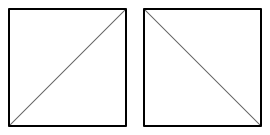
The triangulations of a square.
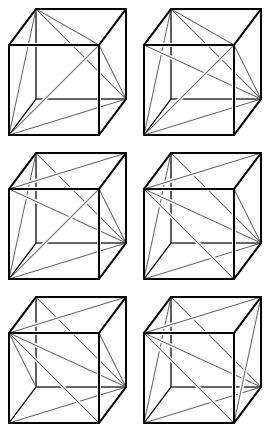
The triangulations of a cube up to symmetry [1].
The square is the 2-dimensional analog of the cube. As can be seen on the right, a square can be triangulated in two ways. These two triangulations are obtained from each other by a flip.
There are 74 ways to triangulate the usual (3-dimensional) cube [1], i.e. to decompose the cube into a collection of tetrahedra that share their vertices with the cube and intersect along common faces. These 74 triangulations can be partitioned into 6 symmetry classes [1,2]. All of these triangulations are regular and, as a consequence, each of them can be transformed into any other triangulation of the cube by performing a sequence of flips. Indeed, the graph induced by the regular triangulations in the flip graph of a set of points is the edge-graph of the corresponding secondary polytope.
What about the
tesseract, the 4-dimensional analog of the cube? The only method fast enough to enumerate them explores its flip-graph,
under the assumption that this graph is connected. I proved the connectedness of this graph in [3]. Part of this proof is computer-assisted: Proposition 3 from [3] is obtained using an algorithm you will find several implementations of
here.
| dimension |
0 |
1 |
2 |
3 |
4 |
| number of triangulations (A238820) |
1 |
1 |
2 |
74 |
92 487 256 |
| number of symmetry classes (A238821) |
1 |
1 |
1 |
6 |
247 451 |
The corresponding numbers are as yet unknown for hypercubes of dimension greater than 4.
[1]
J. A. De Loera, Discrete Comput. Geom. 15(3), 253-264 (1996)
[2]
J. A. De Loera, J. Rambau, F. Santos, Algorithms and Computation in Mathematics 25, Springer (2010)
[3]
L. Pournin, Discrete Comput. Geom. 49(3), 511-530 (2013)