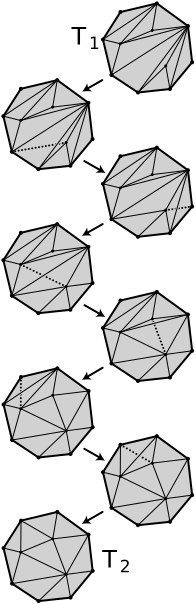
A triangulation is a decomposition of a polytope into finitely-many simplices (triangles in two dimensions, tetrahedra in three dimensions, d-dimensional simplices in a d-dimensional space) that intersect along common faces. Flips are local transformation that can be used to change a triangulation into another triangulation of the same polytope. Prescribing a finite set X of points then gives rise to a finite set of triangulations of the convex hull of X whose vertex set is a subset of X, which are for short, the triangulations of X. In turn, one can consider the flip-graph F(X) of X whose vertices are the triangulations of X and whose edges link two triangulations that can be obtained from one another by a flip. In two dimensions, the simplest flip consists in exchanging the diagonals the convex quadrilateral formed by two adjacent triangles. The figure on the right shows a sequence of flips in the plane.
It is well-known that any two-dimensional triangulation can be changed into any other triangulation of the same set of points using flips [1]. In other words, the flip-graph of a finite set of points in the plane is connected. However, if X is a set of points in a euclidean space of dimension three or four, it is not known whether F(X) is connected in general. In dimension above four, sets of points are known whose flip-graph is disconnected [2,3,4].
A triangulation is regular when the simplices it is made of are projected from the boundary of some (d+1)-dimensional polytope. The subgraph R(X) induced in F(X) by regular triangulations is isomorphic to the edge-graph of the secondary polytope of X [5,6], and as a consequence it is connected. It turns out that this connectedness result can be strenghtened a little: if T and T' are two regular triangulations of X, it is possible to change T into T' by performing flips none of whose remove a face common to T and T' [7].
Triangulation regularity can be generalized as follows to higher codimensions: say a triangulation is k-regular when the simplices it is made of are projected from the boundary of a (d+k)-dimensional polytope and consider the subgraph R(X,k) induced in G(X) by k-regular triangulations. It turns out that R(X,2) is always connected and contains many examples of non-regular triangulations [8]. As an interesting example, Rudin's non-shellable (and therefore non-regular) triangulation [9] turns out to be 2-regular. This can be checked numerically and you will find
here a code that allows to check that Rudin's triangulation is indeed 2-regular. When X is contained in the plane, all the triangulations of X are 2-regular or equivalently, R(X,2)=F(X) [10]. It is not known whether R(X,2) always coincides with F(X) when X is contained in a 3-dimensional space. If it were the case, this would show that F(X) is connected.
[1]
Transforming triangulations
C. L. Lawson, Discrete Mathematics 3, 365-372 (1972)
[2]
F. Santos, J. Am. Math. Soc. 13(3), 611-637 (2000)
[3]
F. Santos, Math. Ann. 332(3), 645-665 (2005)
[4]
J. A. De Loera, J. Rambau and F. Santos, Algorithms and Computation in Mathematics 25, Springer (2010)
[5]
Discriminants of polynomials of several variables and triangulations of Newton polyhedra
I. M. Gel'fand, M. M. Kapranov, and A. V. Zelevinsky, Leningrad Math. J. 2, 449-505 (1990)
[6]
I. M. Gel'fand, M. M. Kapranov, and A. V. Zelevinsky, Birkhäuser (1994)
[7]
L. Pournin and Th. M. Liebling, Comp. Geom. 37(2), 134-140 (2007)
[8]
L. Pournin, Adv. Geom. 12(1), 63-82 (2012)
[9]
M. E. Rudin, B. Am. Math. Soc. 64, 90-91 (1958)
[10]
L. Pournin, Discrete Comput. Geom. 47(1), 106–116 (2012)